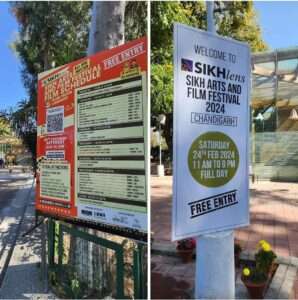
Sikh Lens works beyond boundaries, nurturing Cultural Heritage through its Films and Documentaries.
The Mesmerizing Event unleashed the hidden essence of Sikhism, Art, and Indian heritage.
Sikhism revolves around the timeless principle of proclaiming the presence of a Singular God in every soul, every entity, and throughout all existence, with Shri Guru Granth Sahib guiding us toward an integrated and harmonious way of life.
The event painted a vivid tapestry, weaving together the timeless teachings of “Shri Guru Granth Sahib” ji, the rich cultural heritage and valour of Sikhism, and the imperative to cherish our roots and preserve our principles.

Narinder Pal Singh, a resident of Ludhiana, has devoted nearly 38 years to amassing a substantial collection, including coins and manuscripts of religious texts in Arabic, Gurmukhi, and Farsi, each dating back around 600 years.
His collection also includes cameras spanning from antiquity to the present day, showcasing their evolution over time. Each piece in his collection echoes the whispers of history.
Immersed in his passion, Narinder Pal Singh delved into the realms of royal families, museums, and antique dealers, relinquishing not only his property but also his abode to procure these ancient miniatures.
Immersing oneself in the artistic creations of the Singh Twins, alongside the contributions of Mr. Harinder Singh and Japneet Kaur within “Jewels from Sikh Wisdom,” proved to be an enchanting experience.
The transformative presentation of Japji Sahib, enriched with vibrant imagery, beautifully encapsulated its profound essence, offering a fresh and remarkable perspective.
The artists beautifully depicted the omnipresence of God, intricately portraying the realms of Akaash, Pataal, and Dharti – a visual manifestation of the belief that God resides in every particle of creation.
Through their creative expressions, they breathed life into the Udasis and the teachings of Guru Nanak Dev Ji, depicting them as figures laughing, playing, and adorning fasting, each act is a pathway to liberation.
Colonel Harbaksh Singh, a stalwart with 32 years of service in the Indian Army and a member of the Philatelist Club Chandigarh.
His impressive stamp collection, spanning from Guru Nanak Dev Ji to Maharaja Ranjit Singh, serves as a tribute to Sikh martyrs and sheds light on lesser-known heroes like Bhai Jaitu Ji, Bhagat Puran Singh, and Bhai Jeevan Singh Ji.
It also acknowledges the efforts of Gurvinder Pal Singh in bringing attention to the Saragarhi Memorial after 125 years. Colonel Harbaksh Singh ardently preserves the legacies of poets and artists like Shivkumar Batalvi and Air Chief Marshal Arjan Singh, acknowledging their invaluable contributions.
His collection includes stamps featuring Sikh hockey players and commemorating all states before India’s independence.
Particularly noteworthy were representations of global recognition of Sikhs, such as Bhutan’s commemorative postage stamps honouring Dr. Manmohan Singh.
Furthermore, Colonel Harbaksh Singh’s collection underscores the significant contribution of Sikh valour during World War I and British rule.
A varied collection of books was on display, among which one stood out: an anthology authored by Colonel Parminder Singh which delves into the roles and deployment of Indian soldiers by the British during World War I.
The book sheds light on numerous Sikh prisoners of war in Germany, celebrated for their zeal, bravery, and unique way of life, culminating in the establishment of a museum dedicated to their memory.
Despite the lack of material gains for Indians from the war, their loyalty remained unwaveringly aligned with British rule during that period.
In “Brexit India-1947,” Dr. Swarnjeet Singh adeptly highlights the British exploitation of India’s heritage, weaving a narrative of violation, oppression, and division that eroded the very fabric of integrity and humanity.
Through a careful exploration of overlooked historical intricacies, he illuminates British policies, including the strategic deployment of the Indian army against its people.
Singh delves into the establishment of the expansive Indian army, segmented into Gorkha, Bengal, and Sikh regiments, revealing how their valour was manipulated, alongside the unjust utilization of the Indian army during the World Wars.
Furthermore, Singh scrutinizes the waning British influence over India in the aftermath of the global conflicts.
Apna Farz, Lord and Lady Singh
Manka Dhingra-Breaking Barriers
The Invite
Maa
Sacred Thread in Lima
SatSriAkal-“SatSriAkal” beautifully, encapsulates the idea that truth prevails universally and eternally.
Bruice Singh
Play – Itihas Gvaah Hai
Life of Hockey
Brexit India-1947
The American Sikh
Sikh in Pakistan- Resilience of Faith
The Stevia King
Muntazir
Recitals of Zafar Nama
The Gatka-Sikh Martial Arts performance by young girls symbolizes a move towards equality, echoing the teachings of the ‘Guru Granth Sahib,’ which emphasize the presence of the divine in both males and females, transcending gender boundaries.
Manka Dhingra’s journey as the inaugural Indian-Sikh woman from Bengal to join the United States legislature is truly inspirational.
A Sikh individual in Peru earned admiration by embracing uniqueness and offering equal respect to Christianity, illustrating the profound principle: what you give, you receive in return.
Event narratives also addressed important issues like domestic violence, showcasing resilience and a commitment to eradicate such issues.
Furthermore, the story of an innovative farmer pioneering stevia processing technology with India’s first plant installation represents progress and innovation.
In the tapestry of Sikh revolutionaries from Pakistan, luminaries like Ramesh Singh Arora have not merely breathed life into the fading grandeur of Shri Kartarpur Sahib but are also fervently dedicated to the conservation of Mandirs.
His proactive endeavors extend to championing the cause of Minorities in Pakistan, embracing communities such as Christians and Hindus.
Complementing this narrative is a spirited young architect, passionately asserting that the preservation of heritage, whether in the form of Mandir, Masjid, or Gurdwara, is paramount.
The resounding theme is that strength is derived from connecting to our roots.
The Sikh Lens diaspora extends its hands to every individual, embracing diverse talents, and resolutions, and uniting them under a cohesive canopy.
Commendable work by Mr Bicky Singh – Founder of SikhLens in collaboration with Ojaswee Sharma, a filmmaker, and recipient of the Nobel Award from Chandigarh.
A special acknowledgment is extended to Mr. Ojaswee Sharma, illuminating the tapestry of Sikhism.
Sikhlens: Sikh Arts and Film Festival 2024 (India Chapter)